Because of the full power grid, strict enforcement is being applied to companies that demand too much electricity from the grid. Companies that exceed their contracted transport capacity (CTC) in this way can face substantial penalties. If they exceed this total maximum capacity at any time, and this leads to acute problems in the area, then the owner of the connection can even be held liable for damage suffered by third parties.
It is therefore crucial for companies to stay within this limit – but the electrical ambitions are currently great: an electric fleet and charging stations for guests, a warm office in winter and a cool office in summer, and of course the electrification of more and more machines and logistics.
That’s why here is a list of options, compiled by Stekker, to get a grip on electricity consumption and to continue growing as a company – even if more capacity is not available from the grid operator.
Larger connection
Even though it’s not possible in many places: it’s still important to request that upgrade and join the queue, which lasts from a few months to as much as ten years in some regions. The grid operators can thus adapt to the demand in an area and are thus aware of the wishes of your company. It is therefore necessary to request an upgrade in time.
Peak-shaving
The exceedances of capacity usually happen when too many machines and installations demand electricity at the same time. For example, around 9:00 AM, when the company starts up, many staff plug into the available charging stations, and climate control often also needs electricity to make it pleasant in the office or business hall.
With energy management, coordinated planning and hard configurations of the installation, peaks can be shifted or flattened. Non-essential processes can then wait until the peak is over. This ‘shaving off’ of the peak is called peak-shaving.
Smart charging
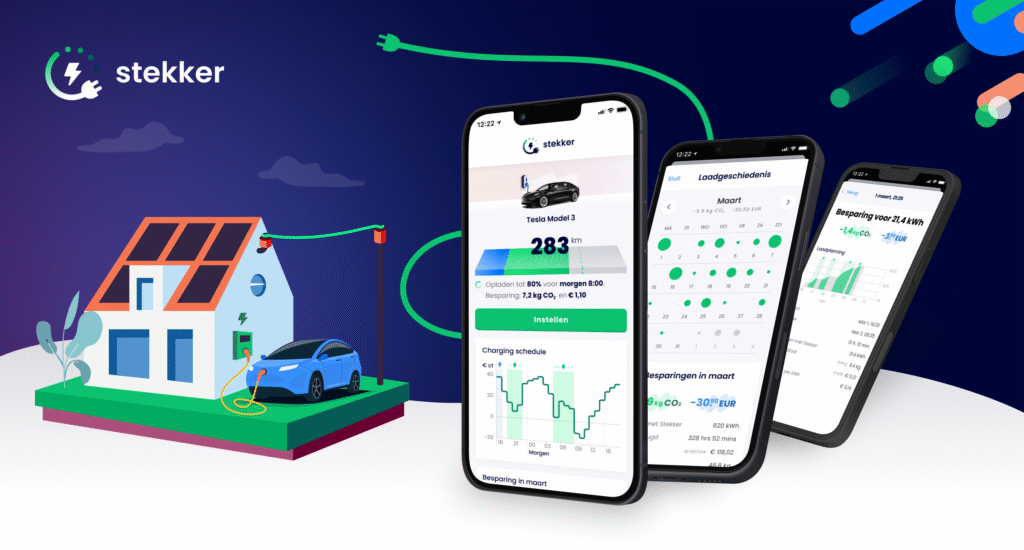
Smart charging means that when charging vehicles, various metrics are considered to make the charging fast or slow. With complex algorithms, charging is controlled to perform optimally compared to the rest of the company, self-generated power, or for example hourly electricity prices.
Stekker does this and can thus, for example, control a charging plaza to give specific vehicles priority in fast charging, or shut off guest use if there is no room for it.
Use more own electricity
The better the electricity consumption of the location is tuned to the generation of electricity from, for example, own solar panels, the less capacity needs to be demanded from the grid. Is there generation of own electricity on the site behind this connection? Then it’s good if the energy management system and smart charging are aware of this – and consumption is well tuned to this generation.
Battery
A solid long-term investment is a battery on location. This allows own capacity to be stored and made available when needed.
A own battery does require a substantial investment if you want to be able to handle the consumption of vehicles or heavy machines with it. (The investment then quickly exceeds a hundred thousand.)
Get insight into electricity consumption
By discovering patterns in electricity consumption, better planning can be made for the electricity consumption of a location, because some behavior on certain days is predictable. If electricity consumption is linked with self-learning software, the planning for electricity consumption can often also be automatically adjusted. Such as some cars could automatically wait with fast charging until noon, when more electricity is available.
Smart EMS Software
The more assets of a location are smartly connected to each other, the better they can be coordinated. Suppose that a food processor always turns on the boilers at 8:00 AM and demands a peak of electricity from the grid – then it’s not convenient if the newly installed charging stations at that time also flow full with hungry batteries that want to charge at maximum speeds.
It’s then better that the charging stations wait a bit, until 1:00 PM, when the boilers go down a notch and maximum sunshine is forecast.
Smart Energy Management Software (EMS) can do all this. It’s a rather broad concept, but it’s generally meant that energy management can be controlled live by (cloud-based) software – based on a possible range of algorithms and preferences.
Non-firm ATO
A “non-firm ATO” means a non-fixed alternative transport agreement. It’s a term used for agreements between grid operators and consumers in congestion areas where there is no guaranteed transport capacity available. This usually comes with a discount.
Such agreements are especially interesting for parties that are flexible in their grid use, because they can free up space on the grid for others and thus help reduce grid congestion and use the grid more efficiently. Who knows, this could help with the challenges in an area, where neighbors free up space they don’t need themselves and which the other can use well.
Optimize climate control / heating
Also take a sharp look at the heating and air conditioning, if this is electrically powered. This can cause significant peaks in electricity consumption.
#contracted-transport-capacity #ctc-exceeded #balance-multiple-charging-stations
Want to know more? Stekker offers advanced smart charging plaza management for load balancing on multiple charging stations, taking into account priorities, limits and preferences of the company. Learn more via stekker.com/ or ask your questions via [email protected]