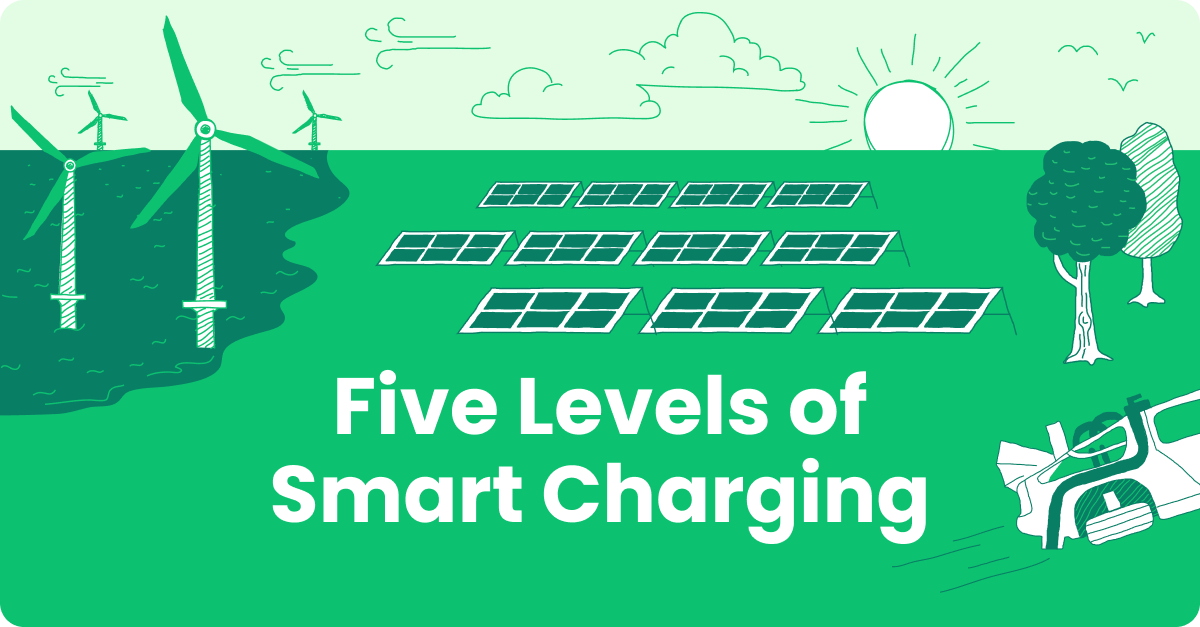
At Stekker we specialize in smart charging. But what exactly does the term ‘smart charging’ mean? Smart charging has been a concept for several years now, but we noticed over the past five years that this term is interpreted differently. Hence an attempt by us – at Stekker – to deepen and make the conversation about this more ambitious, with a whitepaper titled ‘Five Levels of Smart Charging’.
In this whitepaper we describe how we look at the world of smart charging: a model of five levels in which charging becomes increasingly smarter. From manual and labor-intensive at level 1, to fully automatic and connected at level 5. With in between a step-by-step improvement of the complexity and cooperation between people and machines.
In this infographic the five levels of smart charging are explained.

The whitepaper tells more about these five levels and can be downloaded at stekker.com/whitepaper
Why a Whitepaper?
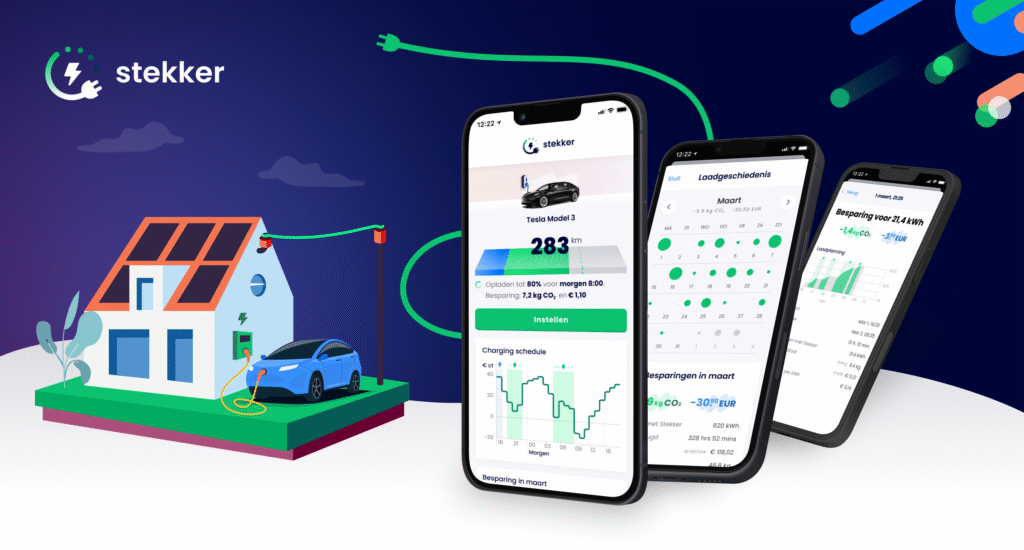
Our app once started with the idea of smart charging at level 2: looking ahead to the day-ahead market to charge at times when prices are lowest. When we started implementing real-time self-generated solar power, we saw that the problem already became a lot more complex.
Many initiatives around smart charging at the moment revolve around getting level 3 smart charging sharp: ensuring that charging can be adjusted in real-time. But we are now also seeing the limit of that coming into view. There is a big challenge to get from level 3 (real-time adjustment) to level 4 (cooperation).
Level 4: Cooperation
In our opinion, the focus of the current discussion should be on level 4: how do we arrive at a degree of smart charging that can (certainly locally) lead to self-regulating smart grids? This first requires further human cooperation.
How do we ensure that different interests in the value chain are well coordinated? That software, plugins and APIs work well together? That risks, finances and rights are well coordinated? Only when that is well arranged – can the software of smart electricity consumption do its work effectively.
At level 4, coordination is therefore done with a higher context than just one’s own wallet. Not only is an external incentive followed – a status is also fed back that lets the higher context know how things are going with the different assets.
Discussion
What it’s mainly about for us is to start a conversation that takes the world of smart charging further. There will be additions, improvements and updates to this way of looking, but we think it’s a valuable addition to the conversation about the power grid of tomorrow.