
Grid operator Stedin calls for not plugging electric cars into charging stations between 4:00 PM and 9:00 PM. According to Stekker – a platform for smart charging of vehicles and optimizing local networks – this rigorous call is not beneficial for electric transport and there are already possibilities to roll out smart charging further. Because Stekker is already smartly controlling thousands of vehicles at this moment.
Smart charging is one of the tools in the toolbox to tackle this problem. By taking into account dynamic prices, grid congestion and local limitations, problems can be prevented and costs kept low.
That there are currently problems is clear: there is traffic jam on the energy grid at peak moments. Stekker therefore calls on all regional grid operators to engage in conversation about how we can roll out smarter solutions further. Because Stedin reports in the media that it is both ’technically and legally’ not easy to force people not to charge their car in the evening peak.
Stekker knows that this is not an easy challenge, but it is certainly not impossible. Because Stekker has been doing this for five years already!
BV Nederland
“This call from Stedin is not good for BV Nederland,” says Marijn Hooghoudt of Stekker. “Those cars still have to be charged, so you can quickly create new unforeseen peaks or problems, even dangerously. For example, a car must always be minimally charged for a trip to the hospital.”
As Robert van Gent of the Association of Electric Drivers already indicated today about Stedin’s call: “This is really thick timber makes planks”. Van Gent fears that a call like that from Stedin can have “a deterrent effect” on motorists considering switching to an electric car. “The call comes on top of the announced abolition of the motor vehicle tax exemption and the opacity of tariffs at public charging stations.”
According to Stekker, a call like that from Stedin can create new problems. New turf wars can arise in charging station land – where different companies struggle for the available space on the grid. It would be much better to look for fine-grained, smart solutions, according to Stekker.
Electric cars are growing faster than chargers, and in combination with the electrification of households and companies we get more problems on our electricity grid. Calls to manually disconnect vehicles at some times may bring some relief in the short term – it is not a structural solution to make our electricity grid future-proof. Stekker’s smart solutions are and already work – so why not start smarter immediately?
How Stekker works
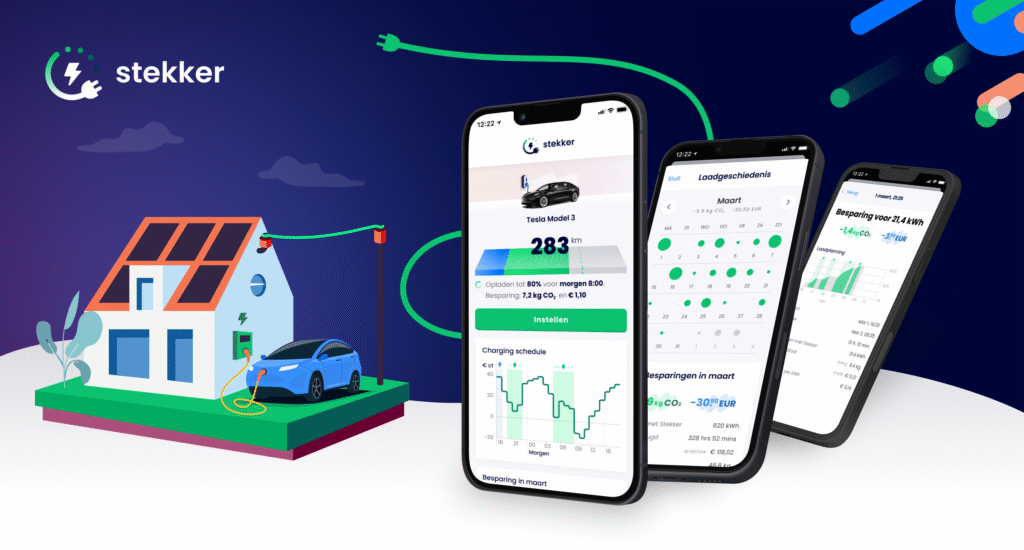
Stekker handles thousands of sessions per day to arrange this smart charging in this way – via direct connections with charging stations and vehicles. Stekker can tell a charging station or vehicle when it is or isn’t a good time to charge: when to charge at full power, at half, or not at all.
High prices and a full grid? Then Stekker ensures that the car waits with charging. Should there be more local limitations, such as limited connection capacity, maximum capacity or a separate contract – then Stekker can also take that into account.
Stekker can thus have different car brands charge everywhere, both at home and at public charging stations, but also controls business locations. A combination of automatic adjustment and for example notifications when charging is finished, ensure the shaving off of peaks in energy use, lower costs and higher use of sustainable energy.
It is not necessary to forcibly turn something off, you can automate this. And the developments in this are going very fast.
Future
In the absence of larger solutions, companies are going to work themselves. We see that now with Stedin’s call, but we recently also saw it with the introduction of prices for returned electricity – a price that is opposed to the netting scheme – which actually pays for returning electricity.
The absence of sharp political choices has worsened this situation. That’s why you see that companies are getting to work themselves to curb grid congestion: at some times there is an abundance of green energy that needs to be used, so prices at those times are lower. Stekker also takes that into account.
This proliferation of measures does not provide structural solutions. Thinking carefully about smart solutions does, says Stekker. Stekker fears that the same unstructured dynamic as with the netting scheme and grid congestion will now arise with companies around charging vehicles.