
The growth of electric cars in the Netherlands is going fast. As of 2024, approximately half a million electric vehicles are driving around in the Netherlands. And although the ambitions for 2030, 2040 and 2050 are regularly expressed and adjusted, it remains to be seen how legislation and regulation will work together with the actual economic transition from fossil to electric.
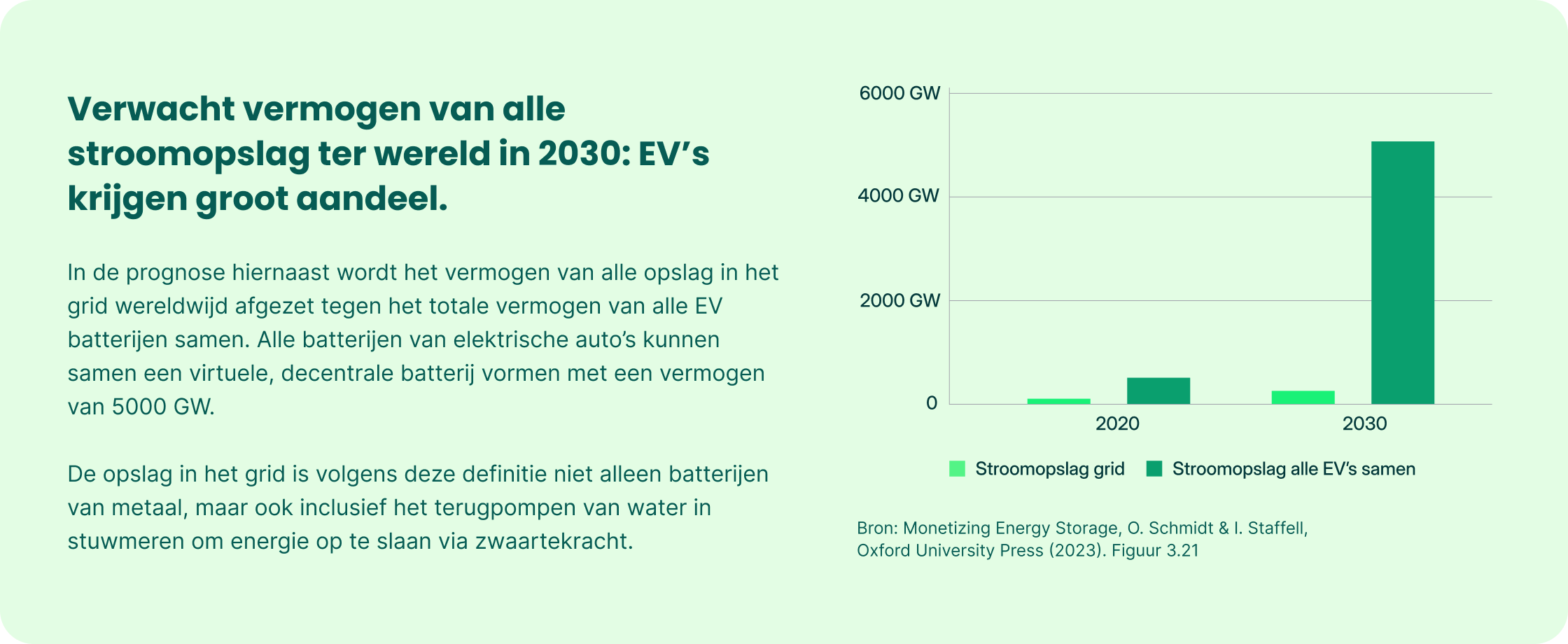
All these electric cars together can ultimately create a virtual battery on wheels that in 2025 alone is approximately 25,000 MWh. And while the largest ’super battery‘ in the Netherlands – opened by the minister in a sea container in Lelystad – barely touches 50 MWh, only 0.2% of that virtual super battery. The scaling up of car batteries is simply going faster. And because these batteries are already made, they no longer compete with other battery needs in terms of raw materials.
Micro batteries in the large grid
These batteries need to be charged regularly – and at those times when they are connected to the grid they can be used well as a flexible shell for the power grid. By charging cars faster or slower – with more and less force at the right times – the power grid can be relieved.
The return of electricity, that is not yet necessary for the vehicles to already be very valuable. So we are not (yet) talking about what is called a Virtual Power Plant in the energy world. We are talking about using the batteries that are now already driving around on four wheels as bundled ‚micro batteries‘ in the very large grid. Where you can store electricity when the grid is too full.
Flexible shell
Together, all these batteries can then provide a strong, flexible shell in the overloaded power grid: heavy energy consumers that can help relieve the power grid – or just hold back when the grid asks for it. This actually makes them something like ‚unidirectional‘ super batteries or grid batteries – but created with software and distributed over the entire energy grid – internationally if necessary.
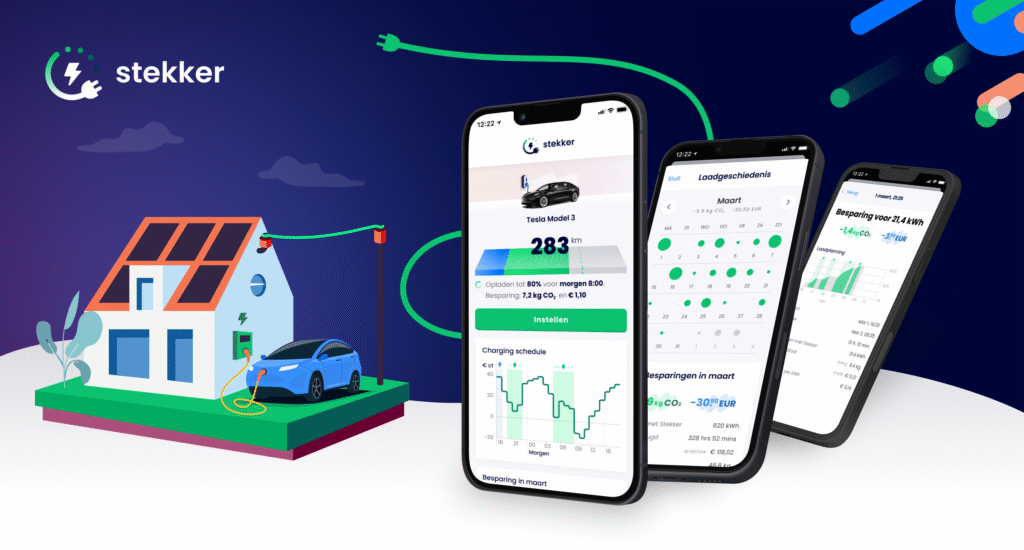
Dealing with our electricity in this smarter way does not have to be future music. The technology to control charging points and vehicles decentrally based on the requirements of the local power grid already exists. Stekker already does this.
The trick is: get digital access to the vehicle or charging point, and control it in a way that is satisfactory for all parties involved.
Are grid batteries the solution then?
Although the technology for grid batteries is not 1-to-1 interchangeable with that of cars (the requirements are different after all), they do compete with each other. The supply chain of grid batteries struggles with the same shortages as that of the automotive industry: the raw materials are scarce, the production lines, technology and manpower for scaling up new and underdeveloped.
In the US, grid batteries are most commonly used, and yet the counter for total installed capacity of grid batteries in 2023 stood at ‚only‘ 8GWh. While 70Gwh of batteries in electric vehicles were sold in that year alone.
Grid batteries thus seem to be a drop in the ocean for now: important in the future, but at the moment we can better use the batteries that are already driving around on four wheels.
Decentralized flex assets
For the Netherlands there is now an opportunity to use EV batteries in a smarter way, because the Netherlands is far ahead of the rest of the world in terms of EV adoption.Controlling electric vehicles in this way means being able to control distributed flex assets: you only need software for it! And sometimes a new SIM card in a charging station: an investment that is a lot smaller than the purchase of a very large battery of expensive material.
That consumers are now called upon to adjust their charging behavior or install an app to charge smartly – is ultimately not a solution for the long term. Because this puts a potential flex asset in the hands of consumers. And that’s not what a robust energy system of the future can rely on.
There is a way to be able to flexibly deploy the virtual battery that all electric vehicles together form in 2025 – and that is through smart charging: capturing peaks of solar power, or helping to capture the ever-growing electricity demand in the right ways.
Levels of smart charging
At the moment it is best to charge smartly via the charging stations, because the connectedness of cars still leaves something to be desired: cars often do not yet have the ability to connect to the internet and receive charging instructions in this way.
Some of the largest brands currently have their cars connected, but are also all reinventing the wheel when it comes to smart charging and charging schedules – or they only offer level 1 smart charging: setting a manual timer.
It takes time before all vehicles and charging points are connected to the larger grid and can work flexibly together via standard protocols. To get to level 4 and 5 smart charging, the manufacturers of all these vehicles and charging stations will first have to work together and agree on standards with each other. Not all vehicles are currently accessible via the internet, APIs are often not publicly accessible to third parties. These kinds of issues are blockages on the way to a more integrated system and will first have to be solved.
Once the charging points have been merged with software, they can easily be controlled as a flex asset. It is then important that the location of the charging point in the power network is known – and that information about any grid congestion at that location is available. By coordinating these two pieces of information, the battery in the vehicle can easily be used to be able to charge smartly.
Many steps are needed to integrate this further. But that we can already use vehicles as flex assets today is evident.