
Companies that exceed their contracted transport capacity (CTC) can face substantial penalties – and can even be held liable for damage suffered by third parties.
It is therefore crucial for companies to stay within this limit – but the electrical ambitions are currently great: an electric fleet and charging stations for guests, a warm office in winter and a cool office in summer, and of course the electrification of more and more machines and logistics. All these assets must be able to work together.
Smart charging is a broad term. At Stekker we use the definitions of smart charging in 5 levels. (Read our whitepaper about it here). In a more ideal world we would already be at level 4 smart charging: all assets talk to each other and are coordinated. Electricity is mainly used and stored when the sun shines or the wind blows, limits are not exceeded, and charging stations or devices that are important get priority in electricity consumption.
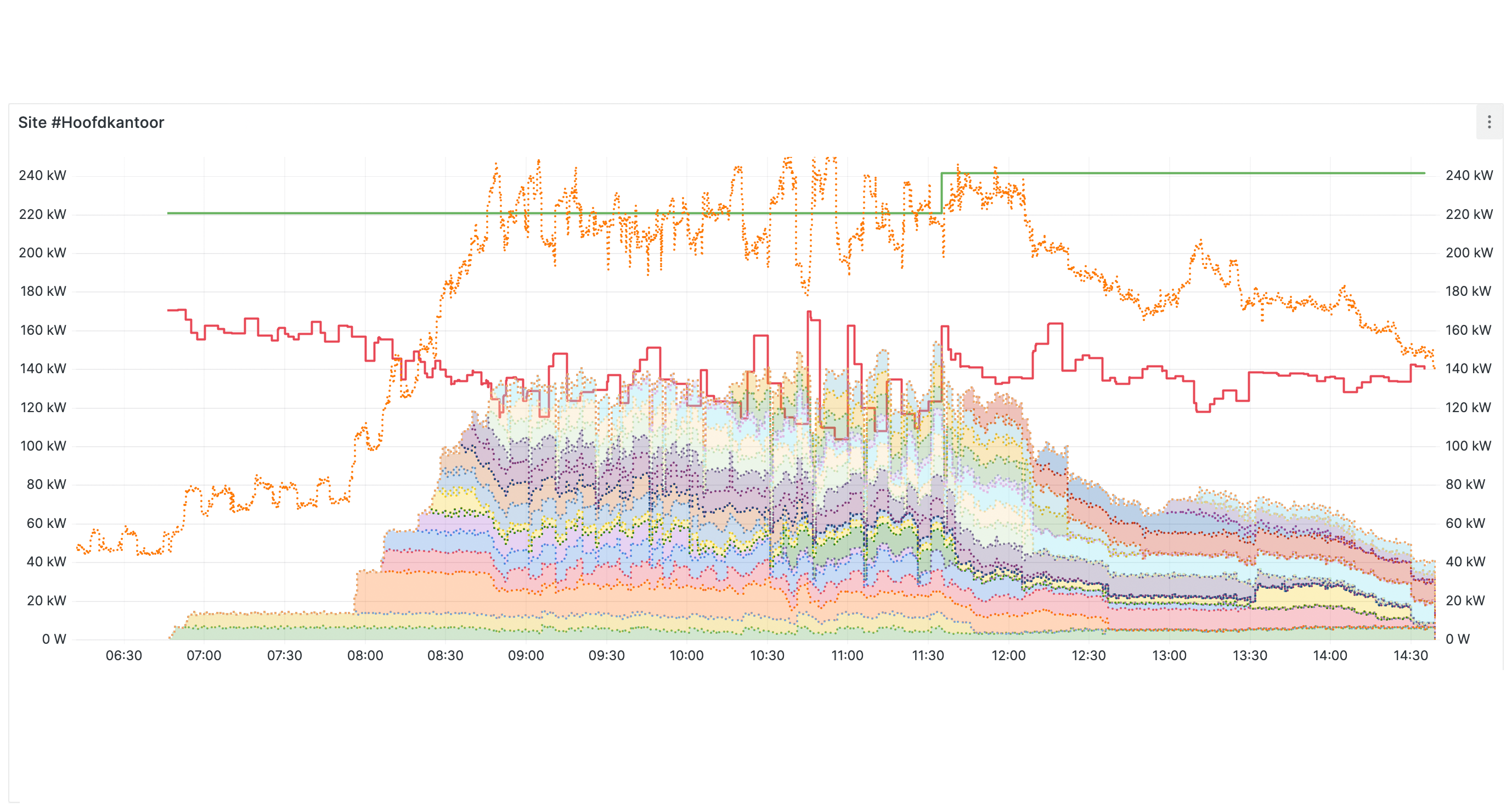
Here charging sessions are seen during the day. By smartly controlling the charging plaza, total consumption can stay within the agreed peak capacity. This prevents exceedances and unnecessary costs, without compromising on availability or charging speed.
Every organization with a connection to the electricity grid agrees on a contracted transport capacity with the grid operator. This is the maximum capacity (in kW) that you may consume or return per quarter hour. There are separate agreements for consumption and for return.
What does smart charging mean?
Smart charging means that when charging vehicles, various parameters are looked at to make the charging fast or slow. With complex algorithms, charging is controlled to perform optimally compared to the rest of the company, self-generated power, or for example hourly electricity prices.
Is there generation of own electricity on the site behind this connection? Then it’s good if the energy management system and smart charging are aware of this – and consumption is well tuned to this generation.
The better the electricity consumption of the location is tuned to the generation of electricity from own solar panels, the less capacity needs to be demanded from the grid.
Want to know more about smart charging? Check out our PDFs.