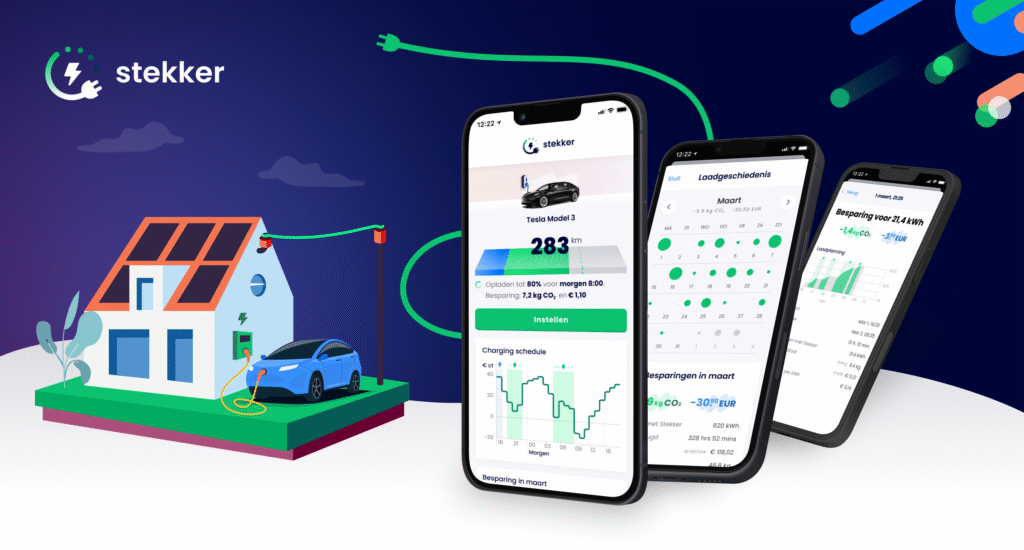
One of the biggest advantages of smart charging is that it can save you a lot of money. But how much exactly? That depends on several factors. We’ll explain.
What determines your savings?
Your savings with smart charging depend on:
- How much you drive (and therefore charge)
- Which energy contract you have
- How flexible you can be with charging times
- Whether you have solar panels
Let’s look at a typical example:
Example calculation: average driver
Suppose you drive 15,000 km per year in an electric car that consumes 20 kWh per 100 km. Then you need 3,000 kWh per year for charging.
Without smart charging:
If you charge at random times, you pay the average electricity price. With a dynamic contract that was about €0.25 per kWh in 2023.
Annual costs: 3,000 kWh × €0.25 = €750
With smart charging:
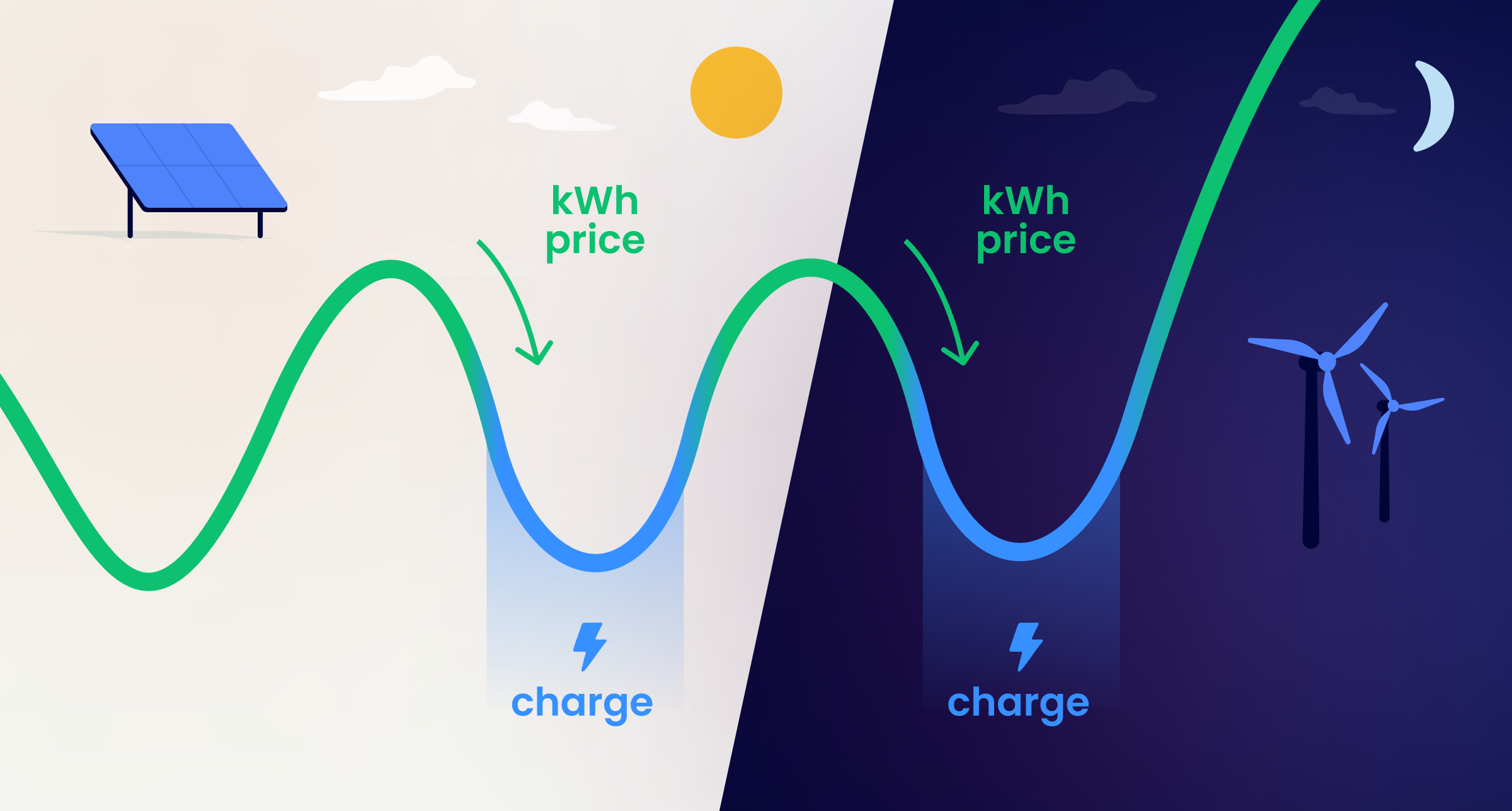
With smart charging you mainly charge when electricity is cheap. On average you then pay about €0.15 per kWh.
Annual costs: 3,000 kWh × €0.15 = €450
Savings: €300 per year
With solar panels it becomes even more interesting
If you have solar panels, you can save even more. Suppose your panels produce 3,500 kWh per year. Without smart charging, much of that is returned to the grid (for which you get less and less).
With smart charging, you can use that electricity yourself for charging your car. You then save the purchase price minus the return price – often a difference of €0.15 to €0.20 per kWh.
If you can charge half of your car with your own solar power: 1,500 kWh × €0.20 = €300 extra savings
Total savings with solar panels: €600 per year
For large drivers it adds up
If you drive a lot, the savings are proportionally greater. For someone who drives 30,000 km per year, the savings can quickly amount to €600 to €1,200 per year.
Additional savings
Smart charging can deliver even more savings:
- No overvoltage fines – Businesses with limited grid connection save on fines for excess
- Longer battery life – Slower, smarter charging is better for your battery
- Lower grid costs – Some grid operators give discounts for smart charging
What do you need?
To achieve these savings you need:
- A dynamic energy contract with hourly rates
- Smart charging software (like Stekker)
- A compatible charging station or car
The investment is limited: the Stekker app is free, and a dynamic energy contract often costs no more than a fixed contract.
Payback time
If you invest in a smart charging station (costs about €500-1,500), the payback time is:
- Without solar panels: 2-5 years
- With solar panels: 1-3 years
After that, you keep saving every year.
The future: even more savings
Savings with smart charging will only increase:
- The difference between cheap and expensive hours is getting bigger
- Returning solar power is becoming increasingly expensive
- Grid operators will reward smart charging more and more
So it’s smart to start now with smart charging. Every kilowatt-hour you charge smartly is a kilowatt-hour you save on.
Want to start saving? Download the Stekker app and see immediately how much you can save.