At the moment, the choice is being made to feed surplus electricity mainly into the grid – and thus effectively store the increased voltage in the metal of our power grid. This voltage increase has a limit at some point.
Vehicles could contribute to relieving grid congestion, by considering their batteries as ‚flex assets‘ on the power grid and charging them smartly at the right times. When it comes to the reinforcement of the grid, the use of software in this way is often still not taken into account: by charging smartly at the right times, by doing smart load balancing, or by better coordinating consumption locally, software can help create more space on the existing grid.
Software can relieve bottlenecks and give more freedom of choice in the reinforcement of the grid.
So there is not yet a unambiguous vision on the technology that indicates how this will work from now until 2030 and beyond. Standards are in full development, but still ready for integration and scaling.
Public and private charging stations are not yet coordinated, the CPOs and the energy companies still talk too little with each other, let alone automated. And different companies still compete on technology that could be a solution for everyone. And most projects around smart charging have still gotten stuck in pilots.
There are still few concrete steps to deploy advanced smart charging in relieving grid congestion. While software scales so much easier than hardware. A complete action plan to implement this smart charging is still missing and better cooperation between companies can be worked on.
From problem to solution
We are now trying to keep the grid stable with a stack of different incentives and emergency measures, which must get a grip on the peaks and the growth. This happens for example through curtailment, imbalance settlements, dynamic day-ahead prices and inverters that automatically shut down when grid voltage is too high.
In a more ideal world, this could all be intercepted earlier, with a flexible demand response that ensures that the electricity consumption of the hardware automatically takes place at other times. With good planning of electricity, live adjustment of charging capacity at both private and public places, and taking into account the availability of sustainable electricity, charging can be better controlled and thus – on a larger scale – ensure that there is more space on the grid.
Margin
Vehicles can thus make a positive contribution to solving grid congestion, instead of being seen as one of the causes of the problem. At times of high demand, they can wait. At times of high supply, they can capture peaks.
Smart charging can give more margin in the upcoming reinforcement of the power grid in different ways. First, you can now already get more capacity from the network that is already there. Second, there is more freedom of choice in where to reinforce, because some bottlenecks can now already be mitigated – or even solved – with software.
Before more ‚copper goes into the ground‘ or aluminum can be hung, software can therefore extract more value from the network and already make it work more efficiently. But what that software should be able to do currently still means different things for different parties.
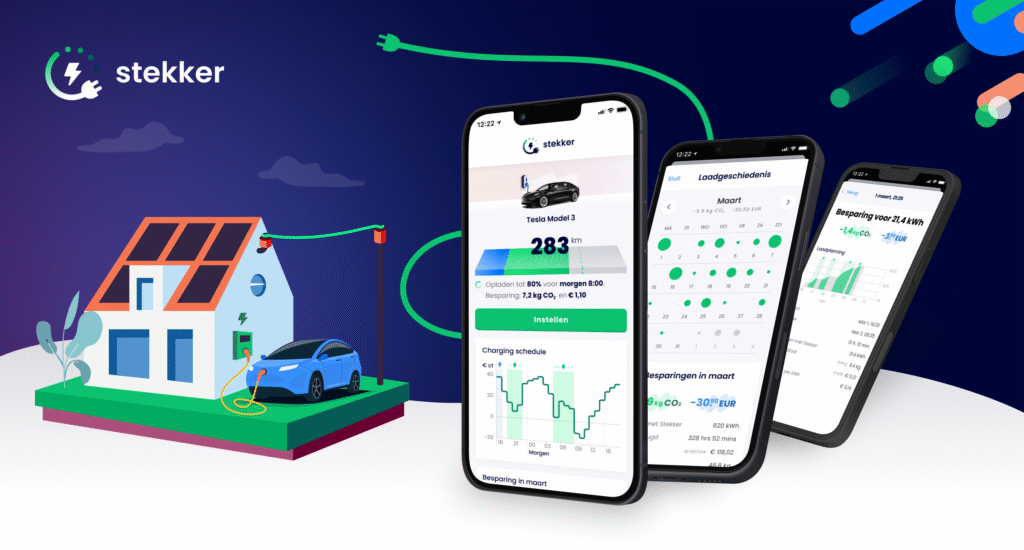
That ideal world is not far away at all: it is being actively worked on and already exists in some ways now. Vehicles and charging stations lend themselves ideally to the flexible regulation of electricity consumption. Thanks to access to vehicles, charging points, data about the weather, car models, dynamic prices and through AI estimates, Stekker already delivers this kind of service today.
At stekker.com/knowledge more can be found about Stekker’s smart charging solutions