
Illustration of the above greenhouse was made with Midjourney.
Increasingly, grid operators have to take emergency measures to stabilize the electricity grid. The main reason is actually a positive development: thanks to the enormous scaling up of solar energy in recent years, enormous amounts of clean energy flow onto the grid at some moments. This is now often thrown away, while we could also use it smartly.
On sunny days, radiant heaters are now often burning away electricity at full settings. Lamps in (empty) greenhouses turn on to get rid of the solar energy. Bitcoin miners see their chance and bake bitcoins from the overheated grid. And out of necessity, water is pumped from one canal into another.
All to stabilize the grid.
Why is this necessary?
Peaks in electricity production must be absorbed. The electricity grid must always be in perfect balance: if too much electricity flows onto the grid from the power plants and solar panels, a solution often has to be found within a few seconds.
If we don’t do that, the voltage on the grid rises, it gets too hot, and devices can go ‚boom‘. It doesn’t get that far in the Netherlands, because of the large and complex network of emergency measures to prevent such a thing. ‚Supply security‘ is a great good in the Netherlands.
If too little electricity is produced, because somewhere suddenly a lot of electricity is consumed, new electricity has to be added quickly. This also now happens with emergency measures, for example by making small gas power plants at greenhouses work harder. These generators usually produce heat and electricity for the greenhouses, but are nowadays also used flexibly to quickly supply new electricity when there is too little electricity available on the grid.
Costs for one is profit for another
The owners of greenhouses have therefore often been making a killing in recent months: a lot of money is put down for all these emergency measures by the energy companies, which are heavily fined for incorrectly predicting the energy market. The closer they are to the actual electricity consumption, the better. The further they are from it, the higher the costs for stabilizing the grid.
Energy companies therefore pay compensations for both burning away the electricity and for cranking up electricity production, sometimes even within the same hour! Count the profit for the greenhouse owners and the costs for society and the energy companies. And think about the waste of all that clean energy, which we could also just use.
Thanks to a surplus of sustainable energy, it’s only getting fuller on the grid, especially during sunny peaks, so this problem seems only to get bigger in the coming years. When the costs can no longer be borne at some point, it’s waiting for things to fail.
Batteries of electric cars
It would be much smarter if we could capture these peaks of clean solar energy somewhere in a way that we actually benefit from it. Sometimes in the media there is talk about using small hydrogen generators, but that’s actually only marginally better. Producing hydrogen is not very efficient, storing it cold also costs energy, and when converting hydrogen back to electricity a lot of energy is lost again: a waste!
What works better then? The batteries of the electric cars that are already driving around at the moment. We don’t have to build those anymore – after all, they already exist – and they need to be charged a few times a week. That’s a lot of electricity that you can time fairly easily.
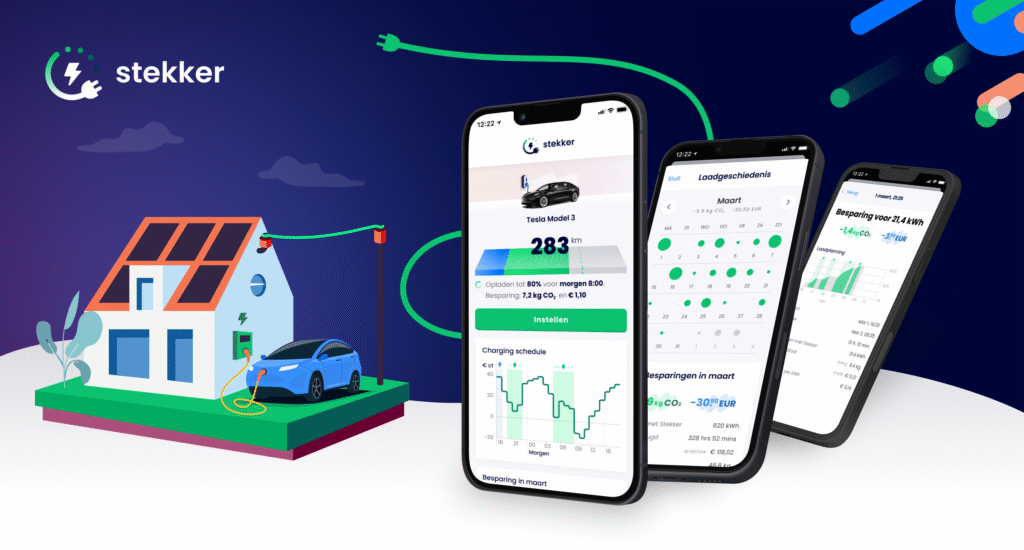
What do you need for it? The Stekker app can help, it automatically arranges charging on solar energy when it’s available. That can already be done today.
In the coming years, more infrastructure and grid reinforcement will also have to come to guide this in even better ways. Dynamic contracts also need to become somewhat better known among people. And it would help if some outdated legal regulations come to an end, such as the netting of solar energy.
But whoever would like to start today with using those peaks of solar energy more smartly, can already start with that today.
About Stekker
Stekker makes smart charging of cars easy. Anyone who wants to get started or help with this mission can of course download the app or take a look at our community platform at community.stekker.com. If you are working on a smart home, you can integrate Stekker on your smart plugs via our IFTTT integrations. Developers can go to developer.stekker.com. We are active on Twitter, LinkedIn, Youtube and Instagram. Subscribe to our newsletter below!