Now EVs are often mentioned as one of the causes of grid congestion – and that’s a shame. By being able to plan and control the electricity demand well, they can actually relieve the grid at other peak moments and the existing network can be used more efficiently than is currently the case.
This can create more space on the grid and companies, schools and new residential areas can get a new connection faster – something for which there are long waiting lists in some regions.
Smart software, which can control the charging stations and vehicles or accelerate them at the right times, is often overlooked in discussions about possible solutions. And yet that software can be the crucial link that can help today.
Help needed
Grid operators are now working to come up with solutions for these new demands, but according to Tennet spokesman Jorrit de Jong it can still take five to ten years before the regions where congestion is worst get significant relief. Until that time we have to make do with restrained growth – or look at the solutions that can help now and will still be of great value in 5 to 10 years.
At the moment, not enough is being invested in reducing that tension by smart charging vehicles in the right way. While software as a solution scales faster than hardware.
If energy companies or grid operators already had access to smart charging of vehicles today, on the street for example, they would use it immediately to flatten peaks in consumption.
They have that to a very limited extent. And that’s why they are now asking consumers, politics and large consumers for help in relieving grid congestion in campaigns.
Smart charging
Unfortunately, this ignores the potential of the virtual battery of approximately 50 GWh that is currently already parked decentrally in the Netherlands, albeit not always with a cable to the charger.
This substantial collection of batteries – on wheels – is charged according to a pattern that is predictable to a certain extent. If we could deal with this flexibly, we could use it to better manage electricity on the grid. Not so much the return of electricity, but precisely being able to dose certain charging sessions at the right times.
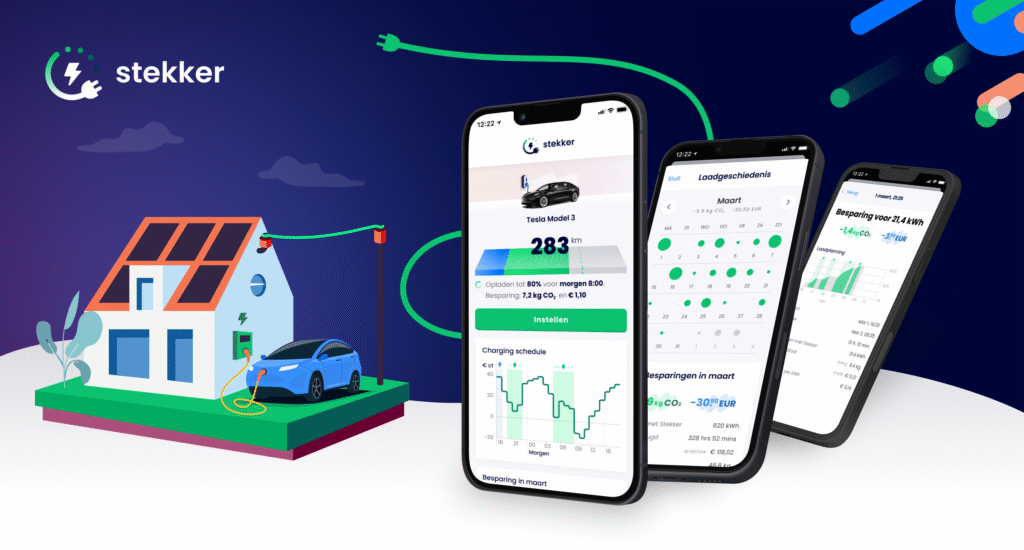
Existing charging points can be upgraded to be in connection with servers that tell them when to charge and when not to, and make the price dependent on that. In this way, a proposition can also be made to end users, who can possibly charge at the most advantageous times while the grid is relieved.
Cooperation
Moreover, it is important in general that charging stations coordinate their electricity use somewhat with the environment. And that the devices in the environment can do that with the charging stations. Because by being somewhat connected to each other with software, a more flexible power grid can be developed that does not have to be dimensioned for the worst rush hour.
Because smarter software ultimately means less grid congestion – and thus more capacity for electricity to go over the grid. By rolling out this highly scalable solution today, immediate relief can be realized for the power grid, instead of having to wait five to ten years for the next phase of reinforcement of the power grid.
By joining hands, we can have already taken enormous steps in further developing the software that can stabilize the power grid.
Want to know more about the knowledge that Stekker has about Smart Charging? Go to stekker.com/knowledge