In the report ‚Smart choices for an affordable and robust energy system‘ – written by a research group from Boston Consulting Group commissioned by Netbeheer Nederland – the researchers explain how smart solutions and good policy can provide significant savings in the future.
On the one hand, they advocate for the investments that are already being made, but aim for the Netherlands to make ’smart choices‘ to deliver the energy system of the future at a sharper price. It calls for the further development of communication protocols, curtailment standards and detailing of control mechanisms.
Their starting points are the challenges that the Netherlands faces:
- The Netherlands wants to import less energy from unreliable countries
- The Netherlands wants to meet agreements to emit less CO2.
- It must remain affordable for citizens and businesses.
To achieve this, according to the report, much needs to happen. From the perspective of smart electricity consumption, we have identified four pillars from the report: Increase flexibility, increase controllability, limit comfort loss and stimulate subsidies.
Increase flexibility
Increasing flexibility on the power grid is one of the pillars of the report. It distinguishes between small consumption from heat pumps to charging stations, to large consumers such as factories, data centers and future electrolyzers or hydrogen generators.
At the moment it is still difficult to properly coordinate energy consumers with the power generators. Therefore, the report calls for the development of standards and protocols for control and flexibilization of electricity.
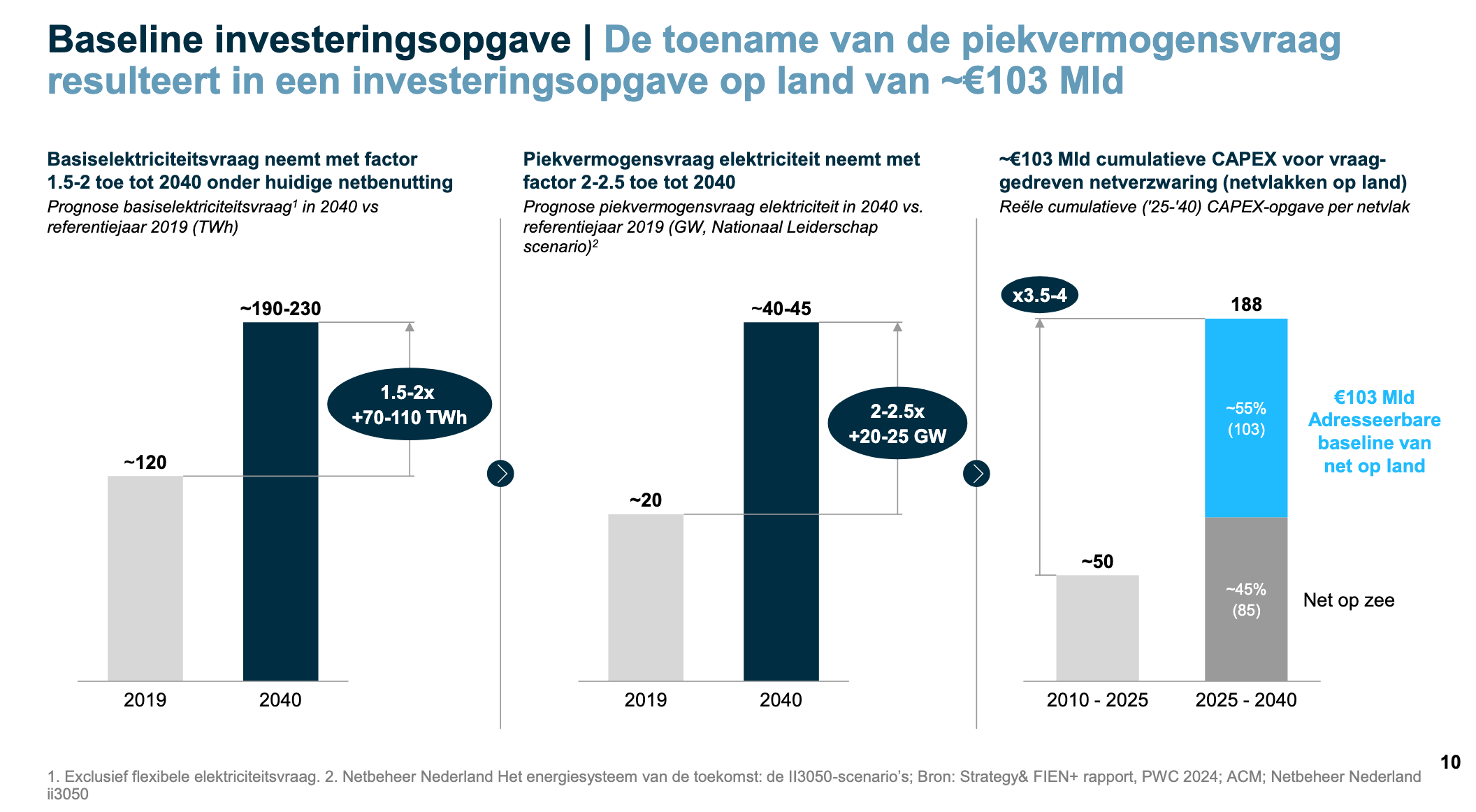
By storing energy and better coordinating the generation and consumption of electricity, the current power grid can actually be used much better. The report cites the expectation that the Netherlands‘ total consumption per year will increase to approximately 70 to 110 TWh per year and that the maximum required peak capacity will increase by a factor of 2 to 2.5 to a peak demand of approximately 45 GW in 2040.
These are significant numbers. Making the electricity grid future-proof is estimated at 200 billion euros by 2040. That money goes mainly to ‚hardware‘ such as heavier cables and new transformer substations. But flexibility can ultimately save 2-11 billion in investments in low and medium voltage networks and another 3-13 billion euros in investments in the high voltage network.
Recommendations
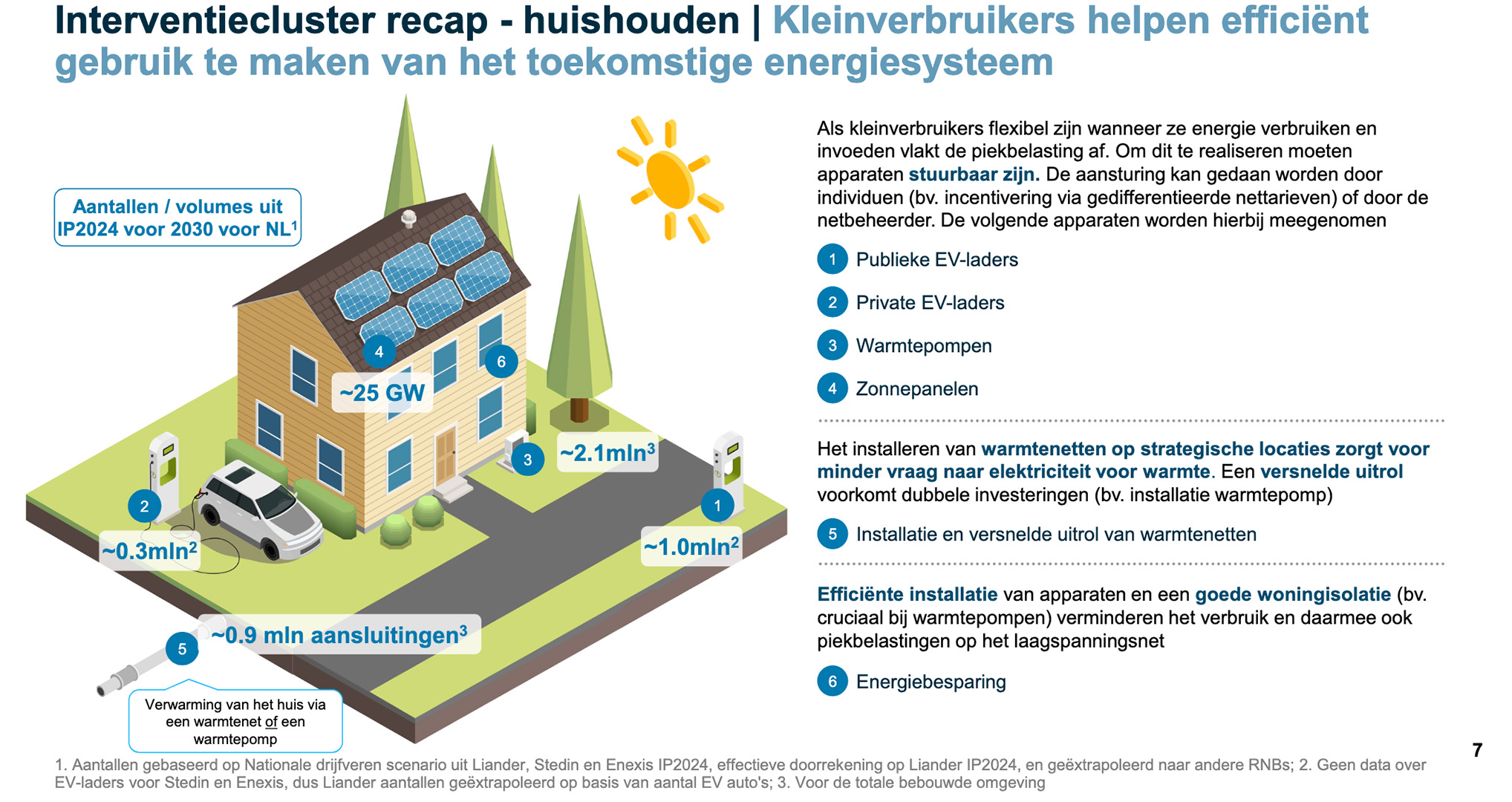
To increase flexibility in small consumption, the report recommends the following:
- Development of new standards for capacity limitation
- Protocols to flexibilize rooftop solar and public EV chargers
- Capacity management of charging stations and heat pumps
- More efficient use of solar panels on roofs to limit peak load
- Stimulating flexible energy use
- New flexible grid tariffs
- Subsidization
- Standardization of flexible use
These measures together can save up to 35% of the costs for the expansion of the low voltage network and reduce the number of bottlenecks on that network by 40 percent. Plus they lead to fewer investments in the medium and high voltage network.
Measures are more effective at an earlier stage of the energy transition, the researchers know. For example, it is easier to steer on location if the assets are not yet built and alternative transport contracts are easier to conclude with a new connection than with an existing connection with an ongoing contract.
Large consumers and flexibility more difficult
The report is less hopeful about the impact of flexibility among large consumers. It thinks that a saving on total investments of about 5% can be achieved there for the grid on land and 15% less on expansion of high voltage and medium voltage substations.
The reason is that not all companies and machines can just work at other times, the possibilities for control are limited, and the software that could control the various assets needs to be better developed.
The intention is that this will be done with financial incentives, such as contracts with dynamic tariffs and alternative/time-block-based transport contracts for industrial players. Ultimately, this will mainly yield savings in the investments in the medium voltage and high voltage network.
Increase controllability
With control or controllability, we also mean the degree to which an asset can be turned on or off, harder or softer, faster or slower by an external source. Especially EV chargers, heat pumps and PV installations receive special attention in the report, because it is necessary that these are well coordinated.
The report calls for the ‚development of curtailment standards‘ for charging stations. This means that charging stations should be able to be turned up and down according to agreed protocols. At the moment there are ways to talk to a charging station, but what exactly is meant by smart charging is often still diffuse and different assets often do not yet communicate effectively with each other.
Standards for curtailing capacity – for public and private EV chargers – can help to better organize software for charging stations, vehicles and heating solutions for moving with the grid.
From 2025, concessions for public chargers should take into account the possibility of controlling the charging stations. The policy recommendation of the report is to also implement control policy for private EV chargers in 2030.
Recommendations regarding controllability
Furthermore, the report mentions the following proposals regarding control:
- Use of incentives to control private EV chargers and heat pumps
- Additional active control on public EV chargers
- Active control of public EV chargers and behind the meter
- ACM grants control mandate to grid operators/external party
- Assets that can handle it should be loaded more heavily
- Expansion of scope of shutdown plans and non-firm contract forms by ACM
- Voluntary or mandatory grid-aware charging for logistics
- Alternative transport contracts (with tariff discounts) for E-logistics
Limit comfort loss
One of the concerns that exists around smart charging is that of loss of comfort for drivers. After all, more time is needed to charge the car, and sometimes with current equipment it also takes some work to get smart control on a charging session. Ideally, the driver actually doesn’t notice much, while the grid is simply stable and billing is done at an acceptable or favorable rate.
At the moment, charging stations usually charge at 11kW at regular public street chargers, the proposal is to make this 4kW at times when the grid requires it. Otherwise, according to knowledge and information center Elaad, consumer comfort is at stake.
For a car with average consumption like the popular Tesla Model Y (16 kWh per 100 km) this will mean that a maximum of 25km per hour can be charged during peak moments.
Depending on the EV and charging profile, most EVs can still be fully charged by morning, while during the day they can usually be charged at full speed. Nevertheless, the report calls for investments to ensure that this comfort is guaranteed.
Stimulate subsidies
The report was written by an external research agency commissioned by Netbeheer Nederland, the cooperating grid operators who are responsible for keeping the power grid operational.
In that context, it advocates for the use of public funds to compensate companies for making their power supply and consumption flexible. The researchers emphasize that investments in energy infrastructure always yield more than they cost.
Unlocking flexibility does have major uncertainties and therefore requires further research, they say. Some existing investments with long depreciation periods sometimes still obstruct the unlocking of flexibility.
The report therefore advocates – with regard to flexibility and smart energy use – for:
- A broader compensation than is currently the case for renewable generation behind the meter.
- Increase of compensations, volumes and durations
- Compensation structures to stimulate more participation in flexible solutions
- Development of a subsidy framework for sustainable generation behind the meter (to encourage decentralized generation and consumption)
- Expand SDE++/Flex-e subsidies for investments in infrastructure, software and processes to offer flex and sustainable generation behind the meter from 2025/2026
- More compensation especially for large industries with integrated processes, for necessary CAPEX investments in case of disruptions
- Compensation, investment subsidies for unlocking flexibility
If all of the above is done, flexibility has a definitive place in the energy system.
As we also wrote before: Also with software, gains can be made. Read more about what smart charging can mean for companies at stekker.com/smart-charging